QR codes are changing out-of-home (OOH) advertising by turning traditional billboards into interactive touchpoints that can engage customers directly. But not every campaign performs well: a poorly designed or badly placed QR code can lead to disappointing scan rates.
What makes one QR code billboard stand out while another goes unnoticed? Execution. As with any print campaign, QR code size, placement, timing, and a clear call to action can all affect scan rates and campaign performance.
This guide covers practical ways to use QR codes in outdoor advertising, helping you create billboards that capture attention, encourage meaningful engagement, and provide analytics to refine your marketing strategy.
Are QR Codes Effective on Billboards?
QR codes are common in magazines, brochures, and videos, where people can scan them at close range. Billboards present a different challenge, especially when viewers are driving or moving past quickly.
Still, QR codes can achieve strong scan rates when they appear in locations where people naturally pause, such as bus stops, traffic lights, and busy pedestrian areas. Even a brief stop can give viewers enough time to notice, focus on, and scan the code.
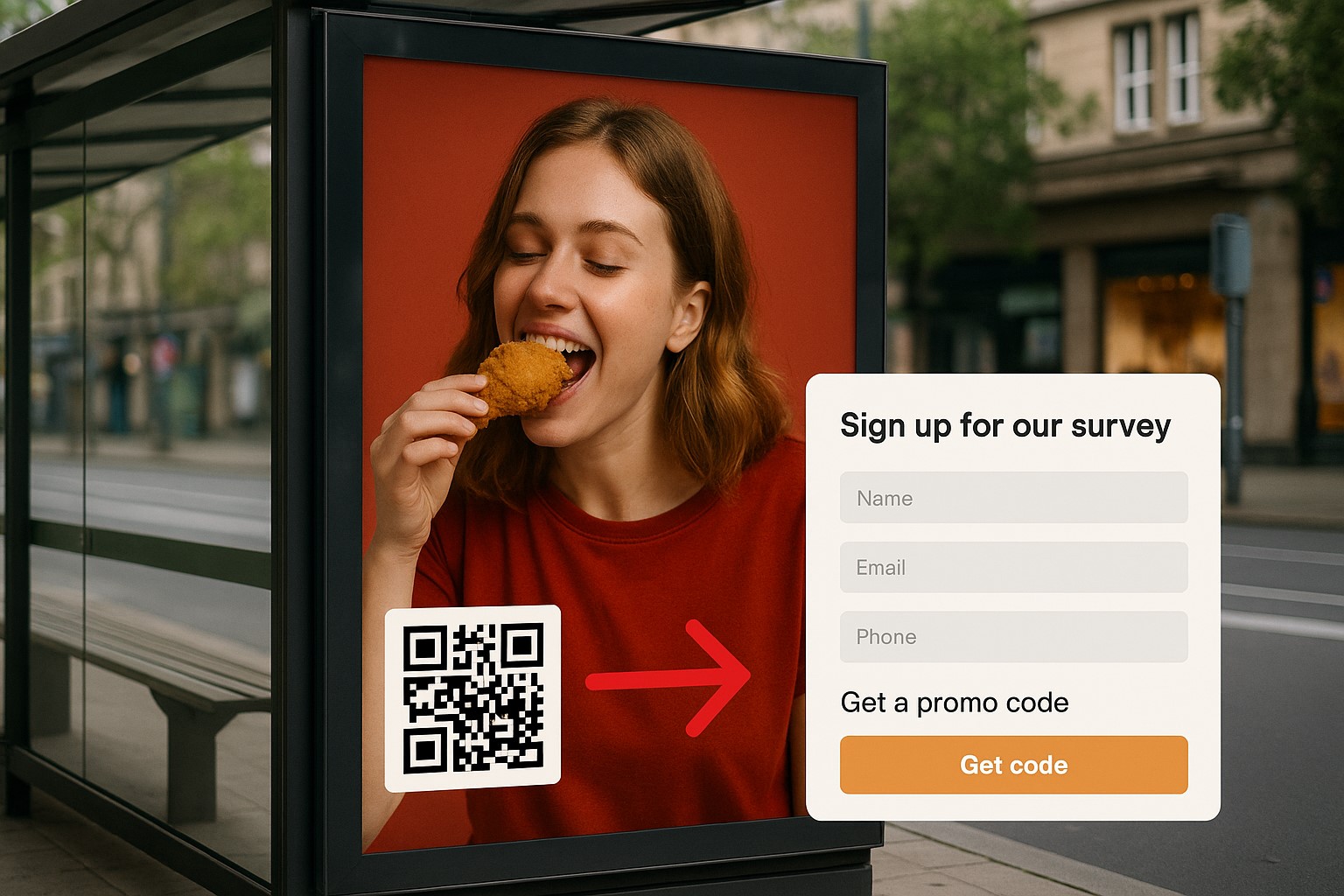
Billboards visible to both pedestrians and heavy traffic, particularly near crosswalks, traffic signals, and waiting areas, create more opportunities to scan. Success ultimately depends on matching the code’s placement to your audience’s real-world behavior.
Give Viewers a Reason to Scan
People rarely want to scan a code that simply leads to a homepage. They are more likely to respond to a story or immediate value, such as a discount code, a mini-game, or exclusive content. Build in a clear incentive that gives them a genuine reason to scan.
A QR code should enable a smooth next step, not merely point people in a general direction. When it automates a meaningful action that is more useful than a simple web search, it gives potential customers a reason to engage with your brand.
Design Billboards for Easy Scanning
Because billboards are viewed from a distance, their QR codes need to follow a few essential design principles:
Negative space helps the QR code stand out.
Strong contrast and appropriate proportions keep the code clear and scannable.
Subtle motion or blinking effects can help draw attention.
Colors, frames, and icons can be added without compromising scanability. A custom QR design can help the code fit the billboard’s visual style.
Measure ROI with QR Codes
Out-of-home advertising has long been difficult to measure. QR codes can help you track:
The number of scans for each billboard
User device data
The location and time of each scan
Assigning a unique code to every billboard makes it easier to identify which locations and designs perform best. Understanding where, when, and how people interact with your codes can help you refine the campaign, replace underperforming placements, or strengthen the messaging.
Best Practices for QR Code Billboard Design
To improve scan rates, follow these core guidelines:
Choose the right size: Allow roughly 1 inch of QR code for every 10 feet of viewing distance. Premium billboards may require codes several meters wide.
Use a clear, concise CTA: For example, “Scan to save” or “Scan for deal.”
Place the code strategically: The bottom-right area or the center of the lower edge of the billboard are common placements.
Optimize surrounding visuals: Keep the code clear of crowded graphics and make sure it stands out from the rest of the billboard.
Track and Optimize Continuously
Assign a unique QR code to each billboard, location, or campaign.
Monitor metrics such as scan time, device type, and location.
Run A/B tests with different CTAs or designs to improve scan rates.
This approach lets you adjust campaigns in real time, focus on the most effective content and locations, and reduce waste in low-engagement areas. A dynamic QR code can support updates to the destination after the billboard has been printed.
When they are designed and deployed well, QR codes on billboards can bridge the gap between offline and online engagement. They provide:
Easy-to-scan codes paired with compelling calls to action
Behavioral data from your audience
The ability to refine campaigns in real time while they are running
Rather than remaining static displays, billboards with QR codes can support stronger ROI and more effective communication across offline channels.